Wednesday, March 6, 2013

Isfahan

Iran's gem

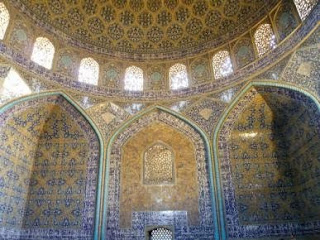
One of my favorite places in Iran is Naghsh-e Jashan Square, one of the largest city squares in the world, as it is surrounded by beautiful masterpieces of Persian architecture.  The colours of the sky and buildings vary between different times of the day but especially beautiful during sunset as the dome of the nearby mosque turns pink against the colourful backdrop of the sun and clouds.  To the west of the square is the Ali Qapu Palace which has detailed wall paintings, ornamented doors and spiral staircases and a highly decorative music and sound room that has intricate plasterwork around the room, providing the best acoustics for the king’s musicians in the past.  On the south side is the Imam Mosque with multi-coloured mosaic tiles filled with rich turquoise, gold and blue colours.  It was especially touching to stand beside the chanter at the mosque making a call to prayer and I could feel the ring of his prayer vibrating from the walls.  I had no idea what he was singing but it was still really moving as I looked up into the high dome in the ceiling during his prayer-it just felt heavenly and I was awashed with a sense of serenity.

 It was pretty cold when I went to Iran, especially during mornings and evenings, so early evening was the perfect time to snuggle into the Qaysariyya Bazaar right at the Naghsh-e Iashan Square for a browse through.  There are all sorts of shops selling Persian handicrafts like carpets, paintings, and carvings as well as lamps, gaz and more.  I couldn’t stop eating gaz in Iran, a Persian nougat candy made from the sweet milky sap from the angebin plant with pistachios, rose water, saffron, egg white.  They’re super sweet but so addictive!  It was amazing to see the detail in Persian hand printed carpets.  They are like works of art hanging from walls and seem almost too previous to be stepped on.  A tradition that dates back to ancient Persia, over 2,500 years ago, carpet weaving is the most well-known craft in Iran, making the country the largest producer and exporter of handmade carpets in the world.  Usually made with a blend of silk and wool, there are also precious ones that are made purely of silk, which are usually hung like tapestries with a frame.  Some of these are so detailed that the weaver must have gone blind after spending years to complete one!

 Next stop: Persepolis!


Wednesday, February 27, 2013

Land of Mystery

Iran: first impressions

I’ve always been curious about Iran.  I’ve heard so much about it yet barely knew anything about it, so over Chinese New Year, I decided that this would be destination for a holiday sightseeing tour.  The first reactions I got when I told people that I was going to Iran were: “Iran!?!” and “Are you out of your mind?”.  Some even mistakenly mixed up Iraq and Iran and thought I was heading into a warzone.  A warzone it definitely was not-it was one of the nicest countries I’ve been to with a wide range of landscapes, beautiful Islamic mosques, friendly and curious people, clean streets and rich Persian history.

 The first thing I had to get used to was wearing a headscarf, also known as a hijab…all day long.  As this is the norm in Iran, all the women on the plane coming from Dubai started putting their headscarves on just before we landed.  It was a good thing that I was visiting Iran during winter time as it would have been arduous wearing a headscarf during 40 degree weather.  The great thing about a headscarf was that I didn’t have to worry about bad hair days during this trip and it almost took awhile to re-adjust when I came back to Hong Kong!  The day that I arrived in Iran was Revolution Day, which falls on February 10 or 11 each year.  This revolution revolved around the overthrow of the Pahlavi dynasty by Khomeini, who became the country’s Supreme Leader in 1979.  We were told that the whole city centre would be blocked off as everyone would be out on the streets, so we headed towards another city-Isfahan, before coming back to Tehran towards the end of the trip.  But I did see live broadcasts of what was happening on the TVs at the airport in the midst of the wait for a landing visa and the streets were packed with masses of people waving Iran’s national flag.  Before heading out of the airport, I got some local currency and was surprised at how much inflation the country is experiencing.  I was told that one US dollar could get me around 8,000 Rials before I left but I got about 22,000 Rials at the airport (better rates if you’re out shopping in the bazaars though).  With so many sanctions on Iran, the country experienced an annual inflation rate of a whooping 27% by the end of last year.  I was a millionaire by the time I headed out of the airport.

 We went for our first meal in Iran before the long bus ride to Isfahan via Kashan.  The shopping complex was a large rest stop and reminded me of an arcade with shops of all sorts from food stores selling colourful spices, cashews, pistachios and the ubiquitous pistachio nougats to stores selling stuffed toys (Spongebob, Winnie the Pooh and Hello Kitty were the ones I spotted most often).   Now the food place was a buffet and it was packed.  Everyone had a huge plate of rice cooked with yellow saffron garnished with pomegranates in front of them and it can be found at every single meal.  The rice is cooked until the water is completely absorbed so it tastes quite dry, but Iranians like to add butter to add a creamier texture to the rice.  Another essential item is the flatbread.  Not my favorite item as few were made fresh and there are always piles of them placed into plastic bags found at every meal.  But the freshly made ones that come right out of the oven are much better!  The third essential item at every meal is the tomato barley soup which was quite sour but filling and I loved eating it with rice.  There was also tah-chin, a rice cake with a golden crust stuffed with marinated chicken which was colourful but quite dry as well.  While the look of the doma wasn’t so appealing, it was my favorite and is essentially a stuffed vegetable, green pepper in this case, stuffed with rice, well seasoned with fresh herbs and simmered in a sweet and sour sauce.  Another dish that you can’t judge by its appearance is the khoresh bademjan eggplant stew-eggplant is the potato of Iran and is often cooked with herbs and tomatoes until it turns into a thick stew.  This was a great sampling of Iranian foods, but little did I know this would be the food I would find at every single meal during my time in Iran-I’m definitely spoiled by the variety of food I get to have living in Hong Kong!

 More on Iran in the next few weeks as I go through my journey to traffic crazy Tehran, beautiful mosques in Isfahan, ancient Persian civilizations in Persepolis, and desert town Yazd!


Thursday, February 7, 2013

Jaipur's treasures

Pink City

With this year’s Chinese New Year and Valentine’s Day coupled into one extra long holiday, what a great excuse to go somewhere foreign, exotic and romantic.  During my trip to India, I stopped in Jaipur, India’s Pink City.  Buildings in this colourful capital of Rajasthan were painted pink to give it a romantic fairy tale feel when the Prince of Wales visited the city in 1876 and even today, this royal city’s still dressed in pink.  

 While the facades of buildings might look pretty from afar, the majority of buildings are in quite dilapidated conditions but one building that’s worth visiting for some camera posing is the Hawa Mahal, Palace of Winds.  The façade of this five-storey palace resembles honeycomb with 953 miniature windows to allow ladies in the past to observe the streets.  Can just imagine the winds that could go through the rooms if all the windows were opened!

 Amber Fort is another must-see.  A former residence for the Rajput Maharajas, it was built with a blend of Hindu and Mughal architecture and even has some cool technological innovations, including a piped water supply that flowed through the edifice, keeping the surroundings cool, much like the modern air conditioner!   The lineups can get a little crazy though, so best to go early, just after sunrise, so you can catch the gorgeous views of the fort as you sit on the back of an elephant to trot up the paths.  The fort is also high enough to allow for great views of the Aravalli Range.  Not to be missed is the Mirror Palace in the fort.  Built specially for his queen, the king wanted to re-create the stars in the skies with this space which is filled with mirrored ceilings, glass and colourful mirror mosaics that would glitter under candle light.  How romantic is that?


Wednesday, January 30, 2013

Qutb Minar

UNESCO World Heritage Site


One of my favorites sites in India is the Qutb Minar in India-a magnificent UNESCO World Heritage site.  Made of red sandstone and marble, the minaret is a tall slender tower that is a distinctive feature of Islamic architecture, providing a place for a call to prayer and this one specifically was built as a victory tower to celebrate the victory of Mohammed Ghori over the Rajput king in 1192.  Tall standing at a height of 72.5 metres, it is the highest stone tower in India and beautifully constructed with alternating angular and rounded flutings.  The structure has been hit by lightning and earthquakes numerous times, as indicated by the inscriptions engraved on the surface of the tower which depict the history of the tower in addition to religious verses and carvings.  You’ll also notice that there is a tilt of about 60cm to the tower, much like the Tower of Pisa, due to water seepage.  While it was used as a watch tower, and before 1981, anyone could enter and climb the 7-storey, 378-step staircase to reach the top, an accident happened in 1981 and since then, access has been closed off.

 Collectively known as the Qutb complex, the tower is surrounded by structures and ruins, including funerary buildings and mosques.  The complex originally had 27 Hindu and Jain temples which were destroyed and replaced by Delhi’s first mosque, Quwwat-ul-Islam, using the remains of the original temples when India’s Islamic ruler, Qutb-ud-din Aibak rose to power in 1192.    

 I highly recommend this site for its intricate architecture and rich history, especially during sunset, as the scenery is just flooded with gorgeous colours.  I’ll let my pictures do the talking…


Wednesday, January 23, 2013

Land of dispute

Simple living in Kashmir 

While Kashmir seemed relatively peaceful when I visited there last month, it is a land of dispute between India and Pakistan and not so long ago in 2010, clashes between Indian forces and pro-Pakistan and pro-independent supporters ended with over 100 deaths.  I could still sense unease with Indian soldiers spaced out along the roads leading into Srinagar.  The well paved roads leading from the airport to the city centre gradually turned into uneven narrow streets.  How our driver maneuvered in and out of unnamed alleys while avoiding the countless number of stray dogs on the streets to reach our houseboat on the beautiful Dal Lake puzzled me.

 Living on a houseboat for two nights was a great break from city life.  Also known as floating palaces, these meticulously carved cedar wood houseboats have between four to five guestrooms and are anchored to the lakeside and manned by a boatkeeper known as the house captain.  The house captain takes of everything on the boat, from adding firewood in everyone’s rooms throughout the night to cooking up homemade dishes for each meal.  Albeit having to replenish with plenty of water and body balm frequently to avoid super dry skin and feeling a little stuffy at times, I loved the smell of the firewood and had a great night’s sleep.  My 10-hour sleep was a little ridiculous compared to the 6 hours that I usually get, perhaps it was from all the carbon dioxide from the firewood.  I was awaken by the chanting coming from the nearby Islamic mosque.  When I went to the verandah to catch a glimpse of sunrise and to breath in some fresh air, the vibrant colours of the boats and shikaras (water taxis), along with the smoke puffing out from the chimneys and misty morning air, everything-just took my breath away.  It was like stepping into a watercolour painting.

 As we made our way to Gulmarg, also known as the Switzerland of India, to view the snow-capped Himalayan mountains, I saw the smiling faces of Kashmirans in the streets living such simple yet happy lives, I was awashed with a sense of gratitude for all the things I have in my life in this land of dispute.


Wednesday, January 16, 2013

Life's a zoo!

The lively streets of India 


Over Christmas, I was in the northern part of India where I visited Delhi, Jaipur, Agra and Kashmir.  It was my first time to India and the second I came out of the airport, the first thing that hit me was the air pollution.  Yes air pollution in Hong Kong is bad, but this was way worse.  As this was during winter and temperatures dropped under 10 degrees, the air became super hazy from all the firewood and biomass being burned to keep warm.  Not before long, I spotted the biomass dung cakes lined along the streets...well at least it's a form of renewable fuel source.

 The second thing I noticed, coincidentally, also environment related (must be an occupational habit), was that there's not a lot of trash in garbage bins, rather, countless piles of garbage found almost on every other street.  I later found out, especially during night time, that these piles of trash are left to grow and grow until they are big enough for a bonfire right on the sidewalk to keep people warm.  This "trash" is not only a valuable resource for humans, but also for animals that roam the streets, of which there's plenty of.

 With goats, cows and pigs rummaging through the trash piles, camels sauntering next to swerving traffic, families of monkeys hopping between rooftops, constant honking from cars and auto rickshaws, the streets seemed chaotic  as the animals keep to their territory on the sides of roads and pedestrians have become experts at avoiding being hit by vehicles...yet it was like a form of organized chaos.  Life's a zoo!