Monday, May 13, 2013

Trip back in time

Medieval Tallinn 

The overnight cruise from Stockholm to Tallinn was around 16 hours, from 6pm to 10am the next morning.  For someone who gets easily seasick, I found the cruise to be pretty calm, and I had plenty of time to take in the gorgeous views of the sunset before heading to bed early.  The next morning, I woke up to the sound of the boat cruising through broken ice sheets.  Everything was very calm and I had an enjoyable breakfast right by the window offering a nice view of offshore wind turbines from a distance.

 Not before long, we reached Tallinn, where we first visited Toompea Hill followed by the historic city centre.  Before climbing up the steps to Toompea Hill, we came across the Russian Orthodox Alexander Nevsky Cathedral.  This magnificent onion-domed structure was built in 1900 during the tsarist Russian empire.  The inside is filled with colourful and intricate mosaics and it also has 11 church bells which sound off before service.  The largest one weighs over 15 tonnes!  We gradually came to the viewing platform which is the perfect spot for a panoramic view of Tallinn with a skyline of old new buildings.  The neat thing is that there are always photogenic pigeons hanging out here.  It might have to do with all the vendors selling roasted almonds in the area.  You can spot St. Olaf’s church in the distance from the platform.  This was the tallest building in the world from 1549 to 1625.  Its 159-metre spire was a very effective lightning rod and throughout the church’s history, its steeple has been hit three times, completely burning the entire structure three times!  Now, the steeple is 124-metres, a much less likely target than before.

 We walked downhill into Old Town which is filled with charming twisted cobblestone paths reminiscent of Medieval times.  We settled into the Olde Hansa Medieval restaurant for lunch, where all the servers were dressed up in Medieval costumes.  It can’t get more authentic than this!  The bathroom was quite amusing as it was pitch black and we had to move in a bunch of candles to make sure we could see well enough and rather than having a tap, a pot of water had to be tipped over in the sink area to wash our hands, very interesting indeed.  The 2km city wall surrounding the historic district is still intact and dates back to the 13th century.  Gothic architecture can be found throughout the district, including the Town Hall, which is the only Gothic town hall still intact in Northern Europe.  Another well-known landmark is the Pharmacy, a small little shop in Town Hall Square which dates back to 1422.  It is the oldest continuously running pharmacy in Europe and has been operated by ten generations of the same family.  It was famous for specialty items such as snakeskin potion, powdered unicorn horn, as well as every day items like tea and marzipan. Today, it’s still a pharmacy, but sells modern products.

 My fascination with famous old towns in Northern Europe continues at the next stop: Riga!


Monday, May 6, 2013

Stockholm City Hall

Site of the Nobel Prize banquet

Stockholm City Hall is one of the iconic landmarks in the city, also known as the Stadshuset.  It sits on Kungsholmen, one of the many islands that Stockholm spans across.  City Hall’s Blue Hall is well known for being the venue of the annual Nobel Prize banquet.  Nobel Laureates for all the Nobel Prizes, except for the Nobel Peace Prize, gather in this hall after the awards ceremonies at the Stockholm Concert Hall each year for a celebration banquet.  For those who want to experience the nobility of the banquet but who are not on the guest list of 1,300 on December 10 each year, the luxurious cellar restaurant Stadshuskallaren in the building offers the previous year’s menu.

 Blue Hall isn’t actually blue as it was named after Ragnar Ostberg’s original designs which did have blue glazed tiles for the hall but he later changed his mind seeing how beautiful the red bricks used in the construction of City Hall are on their own.  There’s a magnificent organ in Blue Hall which is made from 10, 270 pipes, the largest in Scandinavia.  A well known part of City Hall is Golden Hall with its more than 18 million glass and mosaic pieces showcasing pictures of Swedish history.  After dining in Blue Hall, guests are invited to dance in the Golden Hall.  Another interesting space in City Hall is the Council Chamber which has an open roof inspired by a Viking longhouse.  Nearly eight million red bricks were used in the construction of the hall itself.  From the courtyard, the site overlooks Riddarfijarden and offers picturesque views of central Stockholm.  I also love the sculptures by famous Swedish sculptor Carl Eldh by the water-a female Dansen and male Sangen, Swedish for Dance and Song.

 Watch for my next blog for pictures of the cruise from Stockholm to the beautiful city of Tallinn!


Saturday, April 20, 2013

Copenhagen

City of bikes, fairytales and beer! 

I’ve always wanted to visit Copenhagen with its reputation as a major biking city and environmental hub, especially after the COP 15 meeting in 2009.  Like many bike-friendly cities, the city’s dedicated bike lanes are well-used and has a convenient bike rental/sharing system in the downtown area that allows anyone, tourists especially, to hop on and off bikes with a simple deposit which you get back when you return your bike back to any of the numerous bike stands.  Steer into the countryside and you might even catch some gorgeous views of wind turbines.  It’s absolutely amazing that close to half of Copenhagenians cycle to work or school!

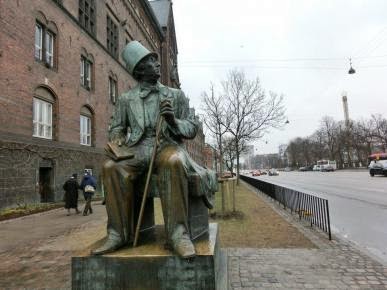
 A biking/walking tour is perfect for a Hans Christian Anderson tour.  You’ll find traces of this storyteller and the characters from his tales all over the city.  There’s a statue of him next to city hall and across from the Tivoli Gardens (the world’s 2nd oldest amusement park).  Anderson’s famed nymph-The Little Mermaid by the harbour has been the icon of Copenhagen for some time.  She has been the centre of attention for tourists and political activists alike.  Apparently her head had to be replaced several times as activists kept sawing it off.  There are also plenty of hidden alleyways and old squares that make this fairytale city so charming.  On a side note, for those who are Shakespearean fans, check out the Kronborg Castle.  It was still under renovation when I went, but it was here that the Bard set his famed play Hamlet.

 While you’re by the harbour, the colourful facades of the Nyhavn waterfront makes it a great spot for photos and with the numerous bars and cafes, it’s also excellent for people-watching!  Can’t get enough beer?  Check out the Carlsberg Brewery Musuem where there are over 20,000 vintage beer bottles.  There are also 8 Jutland horses in the stables that you can visit and they also do wagon rides.  By the time I’ve tried just about every beer there was available at the brewery, it was about time to hit the sack.

 Next up: Sweden!


Monday, April 8, 2013

Iran's capital

Traffic mad Tehran

The first thing I noticed when I arrived in Tehran was the traffic.  Compared to Yazd, Shiraz and even Isfahan, this city is packed.  It’s not surprising that this city made it into the World Health Organization’s list of the world’s 10 most polluted cities.  Being the fifth largest city globally with over 12 million people, the city also has 3.5 million cars, aged cars that is.  The majority of cars are Iran assembled French or Korean cars.  Though the air wasn’t too bad when I went, the city did experience a five-day closure of government offices, schools and banks because of air pollution early this year.  Because of the sanctions on imports of refined gasoline, the country has resorted to producing its own gasoline.  To try to limit the number of cars on the roads, the government has imposed an odd-even traffic control plan based on the last digit of license plates.  But it is a good thing that Tehran is continually expanding its subway system.  While women and men are separately seated on buses in Iran, on subways, the first, last and half of the second and second to last cars are reserved for women but women are still free to ride on other cars freely.

 Tehran is a pretty cool city with a mix of the new, the traditional and the in-between.  The contemporary Azadi or Freedom tower situated in the middle of Tehran’s famous Azadi Square, where many demonstrations leading to the Iranian Revolution took place, is a key symbol of Tehran.  The recently built (2007) Milad Tower stands high at 435m is the sixth tallest tower in the world and offers panoramic views of the entire city.  During my stay in Iran, I had the chance to stay in a few hotels throughout Iran and I’ve got to say that these must have been the best hotels with top notch standards…when they were owned by brand name hotel chains before the 1970s.  Now they’re all government owned.  Being a child of the 80s, it felt like going into a time capsule and landing in the 60s and 70s since the furniture felt pretty retro but at least they were all quite clean!

 One of the draws to Tehran is the National Jewels Museum which houses jewels collected by the Iranian monarchy during its 2,500 year existence, the majority of which were acquired by the Safavid dynasty which ruled from 1502 to 1736.  The crown jewels were last used by the Pahlavi dynasty, which was the last to rule Iran and it was Mohammad Reza Pahlavi, the last king, who decided that the best of the best jewels should be on public display.  You wouldn’t have known that the museum is actually in the basement of the central branch of Bank Melli just by looking at the façade of the inconspicuous building on the outside.  The museum has pretty odd hours as it is opened only from Mondays to Wednesdays for three hours in the afternoon and everyone is required to go on a guided tour.  No one can bring anything inside and there’s of course a security check, so unfortunately I’ve got no pictures, but you’ve always got to see these precious goods for yourself anyways, not just through a picture that somebody else has taken!  One of the must-sees is a jewel-studded globe with over 51,000 gemstones including rubies, emeralds and diamonds and 35kg of pure gold!  The museum also houses one of the largest diamonds in the world, the Sea of Light pink diamond, weighing around 180 carats.  The extravagance doesn’t end there-there’s a Peacock throne that is just covered with gold and encrusted with 26,733 jewels.  My eyes were seriously a little tired from staring at all the glittery jewels in this museum!

 Watch for my upcoming blog posts on my recent trip to Northern Europe and the Baltic countries!


Monday, March 25, 2013

Arid adventures

Yazd: Desert City


Getting to the city of Yazd was a bit of a struggle since our tour bus broke down half way there from Shiraz in the middle of the desert.  After a few unsuccessful attempts at flagging down tour buses, our bus driver assistant started making bonfires at the back of the bus with fuel to make sure other vehicles coming from behind could see us since it was pitch dark outside.  This was also the time when everyone was making use of the flashlights on their phones.  But the good thing was that we could see the beautiful night sky filled with twinkling stars.  Living in cities all my life, I had never seen so many stars!  Just as I thought we were going to be camping on the bus overnight after about three hours, our tour guide was able to flag down a local tour bus (with a little help from the local police) to take all 25 of us to Yazd.  It was a bus filled with twenty to thirty year olds and a few of them were generous enough to offer us their seats so we all could have seats while some of them sat on the bus steps.  It was nice to share with them about Hong Kong and because they rarely see foreign faces, it was kind of entertaining since they were so curious and we were all taking photos of one another.  After a 15 minute taxi ride from the bus station, we finally arrived at the hotel.  I was still marveling at the star filled night sky as I went to my room.

 The next morning, I woke up extra early to get shots of the sky before dawn and it was just the most gorgeous shade of blue I’ve ever seen.  When we went outside after breakfast, we were surprised to see that our driver and tour bus made it to Yazd after all!   As we went towards our first destination, the Towers of Silence, we came across these sand and clay towers that resemble upside down beehives called yakhchal.  These are actually what Iranians used in the past to store ice and food during the winter time in these desert surroundings so that when summers came along, there would be enough to last through the hot months when temperatures climb upwards of 40 degrees.  These were basically the modern refrigerators!  But now they’re just artifacts of the past and if you go inside, all you would see is a huge hole (be careful not to go too far and fall in!).  Some of the buildings in Yazd are built with wind catchers, another clever ancient innovation and is essentially the modern day fan.  These help to circulate air inside buildings.  In Yazd, they’re built either four or eight sided with the open side facing the prevailing wind so that the airflow is brought right into the heart of a building.  The windcatcher functions as a solar chimney and creates a pressure gradient, allowing hot air to travel up to the top.  One of the tallest existing windcatchers is the Dowlatabad in Yazd.  

 Yazd is one of the key centres of Zoroastrianism.  One of the key beliefs of Zoroastrianism is that water and fire are life-sustaining and through fire, spiritual wisdom can be gained while water is the source of the wisdom.  Because corpses are believed to be a host of decay to water and the earth, rather than burying the dead, ritual exposure was used.  The Towers of Silence in Yazd served this purpose.  Dead bodies would be taken to a big pit at the top of the hills to feed to scavenging birds and exposed to the sun.  At the bottom of the burial hills are huts for families to stay in until the whole body had been taken up by birds.  This tradition continued in Iran until the 1970s when it was banned by law and Zoroastrians started burials and cremations.

 Also found in Yazd is the Fire Temple, which holds a torch that has been lit continuously since 470A.D.  Though there are only less than 30,000 Zoroastrians in Iran today, it was a key religion back in ancient Persian civilizations and remnants of the religion can still be found in Iranian culture, such as the Faravahar symbol, a figure on a winged creature surrounded by light.  The figure in the symbol has been associated with a human soul and one of his hands points upward, meaning that believers should strive for improvement while his other hand holds a ring, which is believed to represent loyalty.  The circle from which the figure emerges represents the immortality of the soul.  You’ll also see that the wings of the creature have three rows of feathers, which represent good thoughts, words and deeds, while the three rows of feathers in the tail mean bad thoughts, words and deeds.  The idea is that every Zoroastrian should rise above the bad.  Another key belief is that each person needs to make a choice between good and evil all the time, represented by the streamers stemming from the ring are the spirits of good and evil.  It is very interesting how the beliefs of Zoroastrianism can all be distilled down to this simple symbol.

 Watch for my next blog entry as I take you to traffic crazy Tehran!


Wednesday, March 13, 2013

Persepolis

2500 years of Persian history


Visiting the ancient capital of Persepolis was like travelling back in time.  As I marvelled at the stone wall carvings and what’s left of ancient pillars of palaces that housed Persian kings and queens standing at the hilltop overlooking the archaeological site, I could visualize the grandeur of the great palaces and the procession of noblemen visiting the king and attending lavish banquets, bearing gifts like jewellery and vases in their arms while stately soldiers guarded entrances and stairways…

Situated 70km from modern day Shiraz in Iran, Persepolis was the ceremonial capital of the Achaemenid Empire from 550-330 B.C. during which Darius the Great constructed great palaces, reception halls and military quarters.  Notable structures include the Gate of Nations, the Apadana Palace of Darius, and the Hall of a Hundred Columns.  Alexander the Great destroyed the site in 330 B.C. when he invaded the Persian Empire.

 Right at the entrance of the site is the Gate of All Nations, a square hall that had four columns.  A pair of lamassus, a celestial being that protected kings in Persian culture that is human above the waist and a bull below the waist, stands at the entrance.  Another pair with wings and a Persian head was carved to represent the empire’s power.  It was amazing to see that the structures are still intact after thousands of years, but it was a bit unfortunate to see the amount of graffiti on the walls as past visitors made their marks.

 On the west side of the site is the Apadana Palace-the grandest palace of them all.  With a square grand hall and 72 columns, the structure needed the support on the bottom with its heavy ceiling.  To protect the roof from erosion, there were even vertical drains built through the brick walls of the structure.  There are two symmetrical grand stairways which extend from the foundations of the structure and on the staircase walls are amazing reliefs that show in great detail the traditional costumes of Persian noblemen.  A repeated relief that was found throughout the site was a bull, representing the moon, fighting a lion, representing the sun.  This is a symbol for the Nowruz which occurs at the spring equinox and is also the first day of the Iranian calendar.

 It was amazing to learn about the Iranian and Persian culture from this archaeological site and although the site was destroyed over a thousand years old, the majority of it is still intact.  Pretty cool feeling to stand at the top of the hill with a panoramic view of the entire site!

 I’ll be sharing more about adventures from the desert city of Yazd next week!


Wednesday, March 6, 2013

Isfahan

Iran's gem

One of my favorite places in Iran is Naghsh-e Jashan Square, one of the largest city squares in the world, as it is surrounded by beautiful masterpieces of Persian architecture.  The colours of the sky and buildings vary between different times of the day but especially beautiful during sunset as the dome of the nearby mosque turns pink against the colourful backdrop of the sun and clouds.  To the west of the square is the Ali Qapu Palace which has detailed wall paintings, ornamented doors and spiral staircases and a highly decorative music and sound room that has intricate plasterwork around the room, providing the best acoustics for the king’s musicians in the past.  On the south side is the Imam Mosque with multi-coloured mosaic tiles filled with rich turquoise, gold and blue colours.  It was especially touching to stand beside the chanter at the mosque making a call to prayer and I could feel the ring of his prayer vibrating from the walls.  I had no idea what he was singing but it was still really moving as I looked up into the high dome in the ceiling during his prayer-it just felt heavenly and I was awashed with a sense of serenity.

 It was pretty cold when I went to Iran, especially during mornings and evenings, so early evening was the perfect time to snuggle into the Qaysariyya Bazaar right at the Naghsh-e Iashan Square for a browse through.  There are all sorts of shops selling Persian handicrafts like carpets, paintings, and carvings as well as lamps, gaz and more.  I couldn’t stop eating gaz in Iran, a Persian nougat candy made from the sweet milky sap from the angebin plant with pistachios, rose water, saffron, egg white.  They’re super sweet but so addictive!  It was amazing to see the detail in Persian hand printed carpets.  They are like works of art hanging from walls and seem almost too previous to be stepped on.  A tradition that dates back to ancient Persia, over 2,500 years ago, carpet weaving is the most well-known craft in Iran, making the country the largest producer and exporter of handmade carpets in the world.  Usually made with a blend of silk and wool, there are also precious ones that are made purely of silk, which are usually hung like tapestries with a frame.  Some of these are so detailed that the weaver must have gone blind after spending years to complete one!

 Next stop: Persepolis!