Yazd: Desert City

Getting to the city of Yazd was a bit of a struggle since our tour bus broke down half way there from Shiraz in the middle of the desert. After a few unsuccessful attempts at flagging down tour buses, our bus driver assistant started making bonfires at the back of the bus with fuel to make sure other vehicles coming from behind could see us since it was pitch dark outside. This was also the time when everyone was making use of the flashlights on their phones. But the good thing was that we could see the beautiful night sky filled with twinkling stars. Living in cities all my life, I had never seen so many stars! Just as I thought we were going to be camping on the bus overnight after about three hours, our tour guide was able to flag down a local tour bus (with a little help from the local police) to take all 25 of us to Yazd. It was a bus filled with twenty to thirty year olds and a few of them were generous enough to offer us their seats so we all could have seats while some of them sat on the bus steps. It was nice to share with them about Hong Kong and because they rarely see foreign faces, it was kind of entertaining since they were so curious and we were all taking photos of one another. After a 15 minute taxi ride from the bus station, we finally arrived at the hotel. I was still marveling at the star filled night sky as I went to my room.
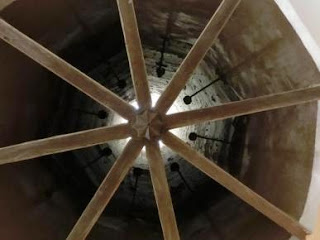
The next morning, I woke up extra early to get shots of the sky before dawn and it was just the most gorgeous shade of blue I’ve ever seen. When we went outside after breakfast, we were surprised to see that our driver and tour bus made it to Yazd after all! As we went towards our first destination, the Towers of Silence, we came across these sand and clay towers that resemble upside down beehives called yakhchal. These are actually what Iranians used in the past to store ice and food during the winter time in these desert surroundings so that when summers came along, there would be enough to last through the hot months when temperatures climb upwards of 40 degrees. These were basically the modern refrigerators! But now they’re just artifacts of the past and if you go inside, all you would see is a huge hole (be careful not to go too far and fall in!). Some of the buildings in Yazd are built with wind catchers, another clever ancient innovation and is essentially the modern day fan. These help to circulate air inside buildings. In Yazd, they’re built either four or eight sided with the open side facing the prevailing wind so that the airflow is brought right into the heart of a building. The windcatcher functions as a solar chimney and creates a pressure gradient, allowing hot air to travel up to the top. One of the tallest existing windcatchers is the Dowlatabad in Yazd.
Yazd is one of the key centres of Zoroastrianism. One of the key beliefs of Zoroastrianism is that water and fire are life-sustaining and through fire, spiritual wisdom can be gained while water is the source of the wisdom. Because corpses are believed to be a host of decay to water and the earth, rather than burying the dead, ritual exposure was used. The Towers of Silence in Yazd served this purpose. Dead bodies would be taken to a big pit at the top of the hills to feed to scavenging birds and exposed to the sun. At the bottom of the burial hills are huts for families to stay in until the whole body had been taken up by birds. This tradition continued in Iran until the 1970s when it was banned by law and Zoroastrians started burials and cremations.
Also found in Yazd is the Fire Temple, which holds a torch that has been lit continuously since 470A.D. Though there are only less than 30,000 Zoroastrians in Iran today, it was a key religion back in ancient Persian civilizations and remnants of the religion can still be found in Iranian culture, such as the Faravahar symbol, a figure on a winged creature surrounded by light. The figure in the symbol has been associated with a human soul and one of his hands points upward, meaning that believers should strive for improvement while his other hand holds a ring, which is believed to represent loyalty. The circle from which the figure emerges represents the immortality of the soul. You’ll also see that the wings of the creature have three rows of feathers, which represent good thoughts, words and deeds, while the three rows of feathers in the tail mean bad thoughts, words and deeds. The idea is that every Zoroastrian should rise above the bad. Another key belief is that each person needs to make a choice between good and evil all the time, represented by the streamers stemming from the ring are the spirits of good and evil. It is very interesting how the beliefs of Zoroastrianism can all be distilled down to this simple symbol.
Watch for my next blog entry as I take you to traffic crazy Tehran!




Getting to the city of Yazd was a bit of a struggle since our tour bus broke down half way there from Shiraz in the middle of the desert. After a few unsuccessful attempts at flagging down tour buses, our bus driver assistant started making bonfires at the back of the bus with fuel to make sure other vehicles coming from behind could see us since it was pitch dark outside. This was also the time when everyone was making use of the flashlights on their phones. But the good thing was that we could see the beautiful night sky filled with twinkling stars. Living in cities all my life, I had never seen so many stars! Just as I thought we were going to be camping on the bus overnight after about three hours, our tour guide was able to flag down a local tour bus (with a little help from the local police) to take all 25 of us to Yazd. It was a bus filled with twenty to thirty year olds and a few of them were generous enough to offer us their seats so we all could have seats while some of them sat on the bus steps. It was nice to share with them about Hong Kong and because they rarely see foreign faces, it was kind of entertaining since they were so curious and we were all taking photos of one another. After a 15 minute taxi ride from the bus station, we finally arrived at the hotel. I was still marveling at the star filled night sky as I went to my room.
The next morning, I woke up extra early to get shots of the sky before dawn and it was just the most gorgeous shade of blue I’ve ever seen. When we went outside after breakfast, we were surprised to see that our driver and tour bus made it to Yazd after all! As we went towards our first destination, the Towers of Silence, we came across these sand and clay towers that resemble upside down beehives called yakhchal. These are actually what Iranians used in the past to store ice and food during the winter time in these desert surroundings so that when summers came along, there would be enough to last through the hot months when temperatures climb upwards of 40 degrees. These were basically the modern refrigerators! But now they’re just artifacts of the past and if you go inside, all you would see is a huge hole (be careful not to go too far and fall in!). Some of the buildings in Yazd are built with wind catchers, another clever ancient innovation and is essentially the modern day fan. These help to circulate air inside buildings. In Yazd, they’re built either four or eight sided with the open side facing the prevailing wind so that the airflow is brought right into the heart of a building. The windcatcher functions as a solar chimney and creates a pressure gradient, allowing hot air to travel up to the top. One of the tallest existing windcatchers is the Dowlatabad in Yazd.
Yazd is one of the key centres of Zoroastrianism. One of the key beliefs of Zoroastrianism is that water and fire are life-sustaining and through fire, spiritual wisdom can be gained while water is the source of the wisdom. Because corpses are believed to be a host of decay to water and the earth, rather than burying the dead, ritual exposure was used. The Towers of Silence in Yazd served this purpose. Dead bodies would be taken to a big pit at the top of the hills to feed to scavenging birds and exposed to the sun. At the bottom of the burial hills are huts for families to stay in until the whole body had been taken up by birds. This tradition continued in Iran until the 1970s when it was banned by law and Zoroastrians started burials and cremations.
Also found in Yazd is the Fire Temple, which holds a torch that has been lit continuously since 470A.D. Though there are only less than 30,000 Zoroastrians in Iran today, it was a key religion back in ancient Persian civilizations and remnants of the religion can still be found in Iranian culture, such as the Faravahar symbol, a figure on a winged creature surrounded by light. The figure in the symbol has been associated with a human soul and one of his hands points upward, meaning that believers should strive for improvement while his other hand holds a ring, which is believed to represent loyalty. The circle from which the figure emerges represents the immortality of the soul. You’ll also see that the wings of the creature have three rows of feathers, which represent good thoughts, words and deeds, while the three rows of feathers in the tail mean bad thoughts, words and deeds. The idea is that every Zoroastrian should rise above the bad. Another key belief is that each person needs to make a choice between good and evil all the time, represented by the streamers stemming from the ring are the spirits of good and evil. It is very interesting how the beliefs of Zoroastrianism can all be distilled down to this simple symbol.
Watch for my next blog entry as I take you to traffic crazy Tehran!


