Friday, October 9, 2015

Living Like a Tourist in North Korea

Food and drink


When I first mentioned going to North Korea, I got asked whether there would be enough food for tourists.  And the answer is a definite yes.  A large portion of the travel fee goes to purchasing food during our stay in North Korea.  With the endless fields of corn in North Korea’s farmland, it’s not surprisingly to learn that corn is a major staple for North Koreans, especially during times of food shortage.  The typical meal for tourists always has kimchi, bean sprouts, scrambled eggs and spicy stir fried pork.  Everyone gets a bowl of rice and North Korea’s rice is probably one of the best in the world, with just the right amount of stickiness and a fragrant aroma.  Another specialty is ginseng chicken cooked in soup.  There’s nothing added besides ginseng and salt, so the taste is quite bland, but the flavour of the ginseng is quite distinct when you taste the glutinous rice stuffed inside the chicken since it has soaked up all the ginseng essence.  Don’t be surprised if the power goes out during dinner time, which happened twice for me, since electricity supply can be unstable.  The most brightly lit places in Pyongyang are probably the Mansu Hill Monument and the Kim Il Sung Square.  Housing units are relatively dark at night, but North Korea does make extensive use of solar panels, which can be spotted on the roofs of most buildings and homes.


The majority of tourists that visit North Korea stay at the Yanggakdo Hotel.  The 170 metre hotel sits on its own island in the centre of Pyongyang.  We were advised to not wander outside of the hotel’s gate by ourselves by our guides.  Built in the late 1980s, the hotel houses about a thousand rooms and most of the furnishings are reminiscent of those in the 80s, especially the sofas.  Hot water is only available during a limited period of time, so showers have to be taken after 8pm.  If you look closely at the elevator buttons, you’ll notice that there’s no fifth floor.  There are stories that share more about the surveillance rooms and propaganda posters that exist on the floor, but I won’t share more about them.  Just Google it and you’ll see.  What I did notice were the tour guides stopping on the same floor in the morning before heading down for breakfast in their separate room.  Perhaps they gather for a briefing before the start of each day, who knows?


As much as the hotel is a five-star one in North Korea standards, I really missed having a comfy and spacious bed to sink into, so three days in the country was enough, at least for the first visit.  We used the brand new airport that just opened up in July.  This is part of the massive plan for North Korea to open up to more tourists and the outside world.  But Air Koryo is the only airline that travels in and out, mostly to other parts of North Korea and China.  The Russia manufactured planes have relatively new leather seats.  No pictures are allowed but I managed to slip a few in!  All in all, this has been an interesting journey and an experience of a country that is so unlike any other, but it will be even more interesting to travel further outside of Pyongyang if I do step foot into the country again.


Thursday, October 8, 2015

The Other Side of the Fence

North and South Korea’s Border


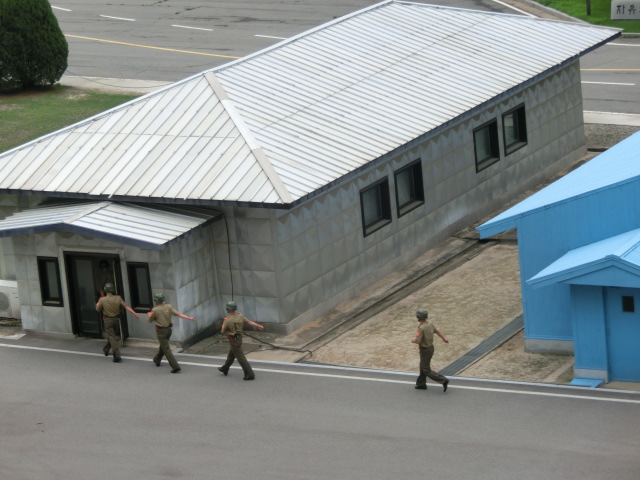
Separating North and South Korea, the Korean Demilitarized Zone was created in 1953 through the Korean Armistice Agreement.  Stretching 250km long and 4km wide, this is the most heavily militarized zone in the world (yes ironic-despite its name!).  Both sides are allowed to patrol with the militarized zone but neither side is allowed to cross the centre line crossing the middle of the zone.  North Korea runs tours that take visitors to the building where the armistice was signed and the conference tables and chairs are still kept intact.  Tourists need to line up to enter the zone to make sure everyone visits the area in an orderly manner, but the soldier tour guide was friendly enough to pose for pictures with eager tourists.  We walked around a small room packed with Korean souvenirs like ginseng and ornaments as we waited for our passports to be checked by the guards.  There’s of course propaganda telling of the need to unite both Koreas for the next generation.  The buildings where the soldiers stand on either side to keep guard stood opposite each other on either side.  We weren’t able to see any visible guards on South Korea’s side although similar tours run on the other side for tourists.  In the past few months, relations have been quite tense due to two South Korean soldiers stepping on landmines suspected to be laid by North Korea and the South responded with the renewed use of loudspeakers broadcasting propaganda against the North.  The “competition” between the two sides even occurred with the flagpoles when each side kept making their flagpole higher than the other.  North Korea’s flagpole is now the world’s fourth highest, standing at 98.4 metres!


Tuesday, October 6, 2015

North Korea: First impressions

The Great Leaders


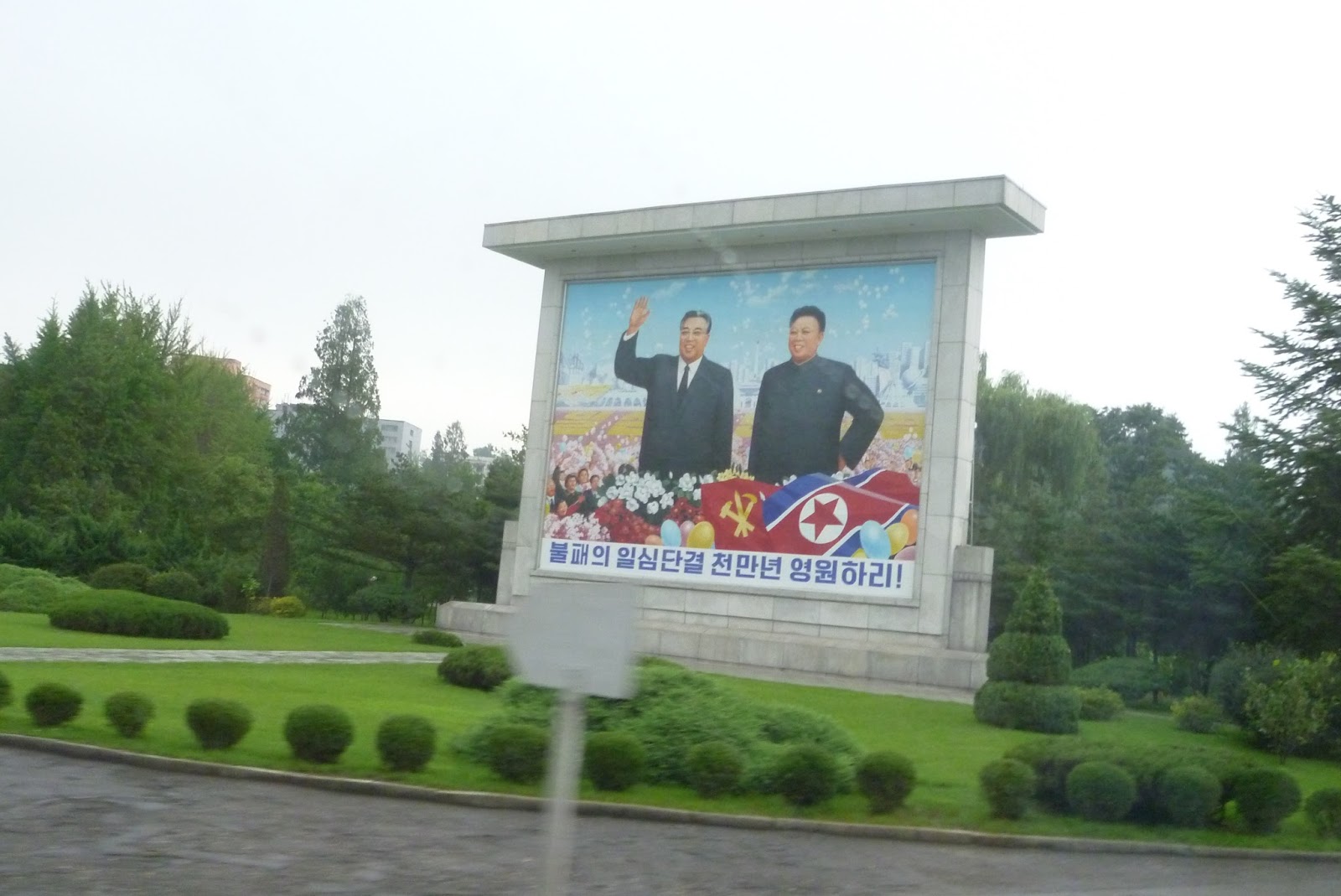
Coming from a city that is perpetually surrounded by advertising, it was odd to see that the only type of advertising that goes on in North Korea are propaganda billboards.  The pictures and paintings of Kim Jong Il-the DPRK’s Supreme Leader from 1994 to 2001 and his father, the Dear Leader Kim Il Sun, can be found everywhere.  Even the billboards without them would have paintings of patriotic soldiers motivating citizens to defend their country and remind them of the importance of self-sustenance.  Juche is the political ideology of North Korea which means self-reliance authoritarian rule.  There’s even a Tower of the Juche idea built, with an eternal fire at the top of the tower.  The idea is for North Korea to have political independence, economic self-sustenance and self-reliance in defence.  These ideas are widespread and constantly drilled into everyone’s minds, not only on billboards, but also on television, where the local channel always airs concerts of war songs, and music videos with images of the atrocities of the war times and of course in newspapers.


The Mansu Hill Grand Monument has magnificent bronze statutes of the leaders.  Our two tour leaders (yes every group has two leaders-one does the talking and the other checks on the other and keeps an eye on the group so always follows last in the group) made sure we bought flowers and lined up single file and bowed to the monument solemnly to show respect.  For North Koreans, their leaders are still alive in their hearts, so we only bow once (instead of three times, when the person has died).  Every North Korean’s essential dress code includes a pin of their great leaders.  A new edition of the pin comes out each year, so we’ve seen different versions of them.  They’re not for sale though.  If someone’s pin gets lost, an application needs to be made for a new one to be issued.  W came across hundreds of students in the Kim Il Sung Square during the day and evening practicing for the mass celebrations in October to celebrate the founding of the Workers’ Party of Korea’s 70th anniversary.  There’s also the Airirang Mass Games that mobilizes tens of thousands of people to participate, but they’ve been cancelled for the past two years.  It takes months and months to organize but people that participate get gifts from the government, like television sets, and packs of food, so many choose to participate in the fun.  

 
The International Friendship Exhibition is a 200,000 square feet museum housing the tens of thousands of gifts that have been given to North Korea’s leaders in Myohyangsan, a two hour drive from Pyongyang.  It was pouring rain that day and flooding in many places, but the potholes on the road were the most annoying part.  Unfortunately, no pictures were allowed.  We had wear shoe covers before entering the larger than life building that is typical of North Korea’s Stalinist architecture and had to bow when we came across the wax statutes of the leaders.  The idea of the museum is to show North Koreans and tourists that the country is so wonderful that the leaders receive gifts from all over the world.  According to unofficial sources, even during the famine years in the 1990s, North Korea still provided aid to Middle Eastern and African countries to build up more allies, so it’s not surprising to see gifts from countries like Libya.  Gifts range from tiger and bear heads to a dining table and even a room dedicated to a bullet proof car and aeroplane from the Russians.  Smaller gifts range from chess sets and pens to suitcases and books-you name it and the museum probably has it!  


Sunday, October 4, 2015

North Korea: Just a train ride away

Getting there


Before we took the train across the border early in the morning, we were warned of the things we had to pay attention to while in North Korea.  We weren’t supposed to mention the phrase “North Korea” because there’s only one Korea.  Even the sign for our tour group got changed to just Korea since our tour guide didn’t want to get lectured for half an hour on the proper name of the country.  At the train station, we spotted quite a few North Koreans with boxes and boxes of goods they were taking back home.  It was pretty easy to tell that they were Korean with the distinct pin they were wearing to respect their leaders Kim Jung Il and Kim Il Sung.  It’s not obvious that we’ve traveled to North Korea if you look at our passports because passports don’t get stamped.  Instead, the stamp goes on a separate piece of paper, which we were instructed to hold on to for dear life because we would have no identity if we were to lose that piece of paper and it’s definitely a priced possession which could sell for a lot in North Korea.  


The train is quite comfy and well air-conditioned.  There are two three-tiered bunk beds in each small compartment and seats by the window.  The train from Dandong to Pyongyang first stopped at Sinujiu for a border check and we were all frantically scribbling down our details on the three border crossing forms as the trained stopped for a border check.  We caught a glimpse of a deserted ferris wheel and soldiers washing clothes outside some buildings after passing the bridge to the other side.  The border guards are well acquainted with electronic devices and they took the liberty of checking for any prohibited photos (pictures of soldiers, political literature).  It was also a chance for the train to re-charge its battery.  We were quite lucky that the train didn’t make frequent charge stops, which happens usually.  Not before long, we were chugging past green pastures of corn and peas.  Curious faces of farmers looked at us and we waved back to say a friendly hello.  It was quite warm and humid in North Korea in August, so kids found themselves some cool by swimming in small ponds amongst the fields.  They greeted us with happy faces and excited hand waves as our slow train went by.  The occasional van passed by, but we mostly saw people on their bikes and cows labouring away in the fields.  Farmers were chatting with each other as they gave time for their sheep and chickens to feed in the lush green grass fields.  Life seems so simple.  We didn’t make another stop until a few hours later when the train staff emptied the trash bins from the train.  Some started walking up and down the aisles selling fruit juices, salted fish and kimchi.  Five hours later, the tall buildings of Pyongyang finally came into view.


Friday, October 2, 2015

North Korea

Prepping for the Trip


North Korea has been on my travel list for awhile but it was only recently that tours have started back up after months of tourist restrictions to the country due to the Ebola and respiratory syndrome cases spreading around.  All tourists have to be part of a tour group to travel to and around North Korea.  This particular tour I joined started in Shenyang and then heads to Dandong, the border town next to North Korea, before embarking on a day long train journey across the border through to Pyongyang.  Korean shops and signs can be found everywhere in Dandong as there is a significant amount of trade between the city with North Korea.  

 
Sitting across from Dandong is Sinujiu and the cities are connected by the Sino Korea Friendship Bridge.  Parts of an older bridge built between 1909 and 1911, also known as Broken Bridge, can be seen alongside the bridge, a reminder of the American intrusion into the countries during the Korean War.  Built by the Japanese during its occupation of Korea between 1937 and 1943, the bridge was bombed by Americans during the Korean War to cut off supplies from the Chinese to North Koreans.  While it is relatively easy for Chinese people to travel to North Korea, South Koreans aren’t allowed in, and many join the boat tours that travel along the Yalu River sitting alongside China and North Korea to catch a glimpse of the North.  At night, there’s a huge contrast between the activity-filled and brightly lit Dandong side and the dark and lifeless Sinujiu, an eerie reminder of what lies on the other side is a country whose people are completely closed off to the rest of the world.  It’s a place where people live with little worry about how much they earn or being homeless because everything is provided for, until famine strikes and there’s nowhere to go because no one is allowed out of the country, which was what happened in the 1990s when many “defectors” made deadly escapes to flee the country.  


Friday, September 11, 2015

Zhangzhajie

Picturesque Hunan


Famed for its beautiful mountainous landscapes and the background for the film Avatar, Zhangzhajie is in the northwestern part of Hunan province.  The ride from Changsha was a lengthy six and a half hours before we reached the ancient town of Fenghuang.  With wooden houses standing on the banks of the Tuo Jiang River that flows through the town, this beautiful water town is still inhabited by villagers that still sustain themselves by fishing on the river and taking tourists on boat rides.  The town is predominantly inhabited by the Miao people who specialize in batik art and making silverware.  With the help of contemporary writer Shen Congwan’s novels, the beauty of this ancient town has spread far and wide.  From Fenghuang, it was only a few hours before we got to Zhangzhajie.  We first went on a boat ride on traditional Chinese boats on Baofeng Lake before heading up to the mountains.  From the lake, there’s a good perspective of the mountains with misty tops.  The eye opener at Zhangzhajie is Yuanzhajie.  We zipped up the surrounding mountain on a 342 metre elevator which only took a few minutes before we found ourselves around mountain peaks of various levels.  These natural and irregularly shaped columns rise from deep valleys and are covered with pine trees that disappear in and out of view in the cloud mist.  It’s never enough to look at the mountains from one perspective in Zhangzhajie since there’s always something different depending on the flow of the clouds and the foliage cover.  This ever changing beauty of Zhangzhajie makes it one of the most picturesque spots for nature lovers to enjoy.