Tuesday, June 10, 2014

Guizhou

Waterfalls, waterfalls, waterfalls 

Spanning 81 metres wide and 74 metres high, the Huangguoshu Waterfall is the biggest waterfall in Asia.  Together with smaller waterfalls, unique and welcoming ethnic minorities in their traditional dresses and the occasional monkey looking for food from the generous (or unaware) tourist, this is definitely a must-see in Guizhou.  Guizhou is supposed to be rainy all year round, but it was actually sunny when we visited, so the waterfall didn’t span as far as it did usually, even so, it was still really magnificent.  What’s really amazing is that you can view and experience the waterfall from different viewing platforms not only across from the waterfall in all directions, including a bird’s eye view and but also behind the waterfall into the Water-Curtain Cave, so be prepared to get wet.


Friday, April 25, 2014

Mosques of Brunei

A day in the life of royalty 

Muslim mosques are found everywhere in Brunei.  One of my favorites is the Sultan Omar Ali Saifuddin Mosque, named after the 28th Sultan of Brunei. The central dome is made of pure gold and sparkles beautifully against the sun’s rays.  The mosque incorporates Italian and Mughal architectural styles and sits in an artificial lagoon with marble bridges leading to the structure.  I especially like the reflection of the mosque in the still water during sunset.  To really see how the royalty lives in Brunei, a trip to the Royal Regalia Musuem is a must.  Everything from the gifts to the king to chariots in the royal parades can be found.  The Jame’asr Hassanil Bolkiah Mosque is the largest in Brueni, built for the commemoration of the Silver Jubilee of Sultan Haji Hassanal Bolkiah as Sultan. The marble minarets and gold domes of the mosque stand out in the picturesque scenery which is filled with lush greenery and flowers.


Monday, March 10, 2014

Alila Villas Soori

Bali Paradise

If you’re looking for some peace and quiet for your next holiday destination with a luxury eco resort surrounded by beautiful black volcanic sands and lush green rice paddies, Alila Villas Soori in Bali is the idyllic spot.  Located about one and a half hours from Denpasar Airport, this lovely paradise sits on the southwest coast of Bali, away from the hustle and bustle of visitor magnets Kuta and Seminyak.

Arriving on a late afternoon flight from Hong Kong, we were greeted by a friendly escort at the airport and our Alila Villas Soori driver who welcomed us with cold towels and water.  The van was even equipped with insect repellent and sunscreen from Alila Living, a touch of some of the finer details we love so much about Alila.  Whizzing by busy roads, markets, and villages, we drove through the quieter rice fields before pulling up to the resort’s entrance.  Designed with cool grey and natural sand colours, Alila Villas Soori’s architectural style gives off a sense of tranquility that we instantly felt. We were brought cold towels and welcomed with some refreshing facial mist as we admired the glistening reflective pond and were pleasantly surprised with frogs hopping around the steps, just part of the natural fabric the resort blends so well into.  After sipping on a warm cup of lemon ginger tea with honey and lemongrass stirrer, a typical Balinese drink that we’ve started making since we’ve been back, our personal villa host showed us to our Beach Pool Villa which has direct access to the glistening black volcanic sand beach.
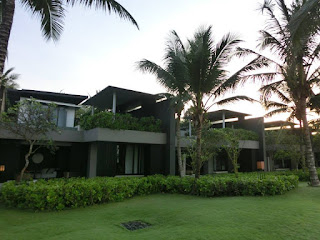
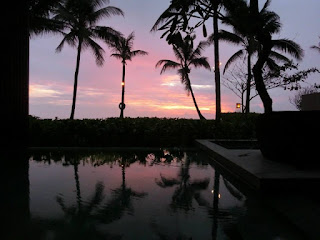
Beautifully furnished with Balinese wooden furniture and plenty of candles for a romantic atmosphere, the spacious villa has a set of doors that open directly to the infinity pool which is great for watching sunsets as well as a separate door that leads to a deck area overlooking the crashing waves from the Indian Ocean in the distance.  Each villa is complete with modern luxuries including a Nespresso coffee machine, an Apple TV, his and hers Alila Living products (including some lovely lavender bubble bath perfect for soaking into the villa bathtub), not to mention speedy wi-fi access.
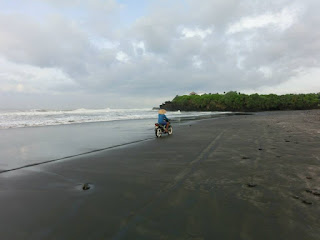
Awakening to the sounds of waves the next morning, we walked along the volcanic sand beach and sauntered around the lush greenery on the property, admiring the natural beauty of papaya and coconut trees along with the recent addition of an organic herb and vegetable garden.  We especially love the moss and tropical greenery along the resort’s stone walls and were greeted with friendly smiles from the resort staff, many of whom come to work from the local Kelating village.   Guests are encouraged to stay active with a 90-minute yoga class in the morning and if you want to practice your mobility skills, venture on a car-free trip in the rice paddies on a Segway, but be sure to practice on the property before taking off!
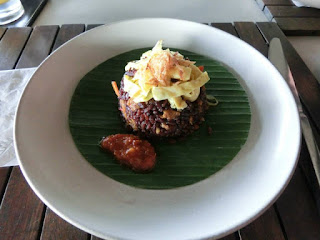
After some morning exercise and yoga, we were looking forward to a delicious breakfast at Cotta, Alila Villas Soori’s open-air restaurant that serves Western favorites like egg benedicts, muesli and freshly baked croissants as well as traditional Balinese dishes such as Nasi Goreng.  Unlike breakfast at other hotels, breakfast menu items change daily and are made when ordered.  The tapas portions enable guests to try a selection of everything.  One of our favorite desserts at Cotta is the black sticky rice with fresh mangos and coconut ice cream, perfect for any time of the day.  If you feel like having a snack in the afternoon, the Reading Room, which is stocked with magazines and plenty of sofas and outdoor seating, offers a complimentary afternoon tea set beautifully and includes a selection of sandwiches, jams and sweets.  For a lazy afternoon treat, we couldn’t resist a Balinese massage at the spa sanctuary.
Alila Villas Soori doesn’t just blend into the local environment in its physique.  Being a socially responsible neighbour, it provides financial assistance to neighbouring elementary schools for repairs, educational materials and supplies.  It also supports SOS Children’s Village, a harmonious village that helps children who cannot be cared for by their biological families to develop skills and capacities, including cultural traditions such as Balinese music and dance.

Wednesday, February 19, 2014

Brunei

Kingdom on Borneo 

The kingdom of long-nosed monkeys, lush mangrove and rainforests, and rich oil reserves-this is Brunei.  I visited this laid-back country and was surprised at its lack of developments even though it is one of the richest countries in the world.  This small country on Borneo is well-known for its oil industry, which is largely dominated by Shell.  Crude oil and natural gas production makes up 90% of the country’s GDP.  I was expecting to see highrises with elaborate architecture and design in this rich country, but was surprised at the flat terrain and simple way of living led by those living with Brunei.  It was interesting to learn from locals that the wealth of the country is distributed quite evenly to the citizens.  Did you know that free education extends through to university, even for university abroad?  Citizens also get free medical care and subsidized housing!  But one thing that I found quite annoying was the lack of public transportation and the huge amount of cars in this small country-not surprising with the cheap oil.  However, this was made up by the delicious and affordable Malaysian inspired cuisines found everywhere, at restaurants and especially night markets which is filled street food like nasi katok (rice with spicy gravy and chicken wrapped in paper) and seasonal fruits such as king bananas, durian, and rambutan.  What you won't find is alcohol though in this Muslim country. More on Brunei on my next blog!


Thursday, December 5, 2013

Bethlehem

Birthplace of Jesus 

One of the destinations that I was especially anticipating to visit during my trip to Israel was the Palestinian governed city of Bethlehem.  For Christians, this is an important holy site since it was here that Jesus was born.  Located on the West Bank, Bethlehem is separated from Israel by the 500km Israeli West Bank barrier.  Built by Israel, the “wall” (also known as the Apartheid Wall and barrier) prevents Palestinians from crossing the border.  It is filled with graffiti expressing discontent and loss of freedom but also the need for peace.  Coming from Jerusalem, I could quickly spot the difference in wealth between Israel and this Palestinian-administered city.  Bethlehem’s streets are lined with fast food and souvenir shops in buildings that look aged and forlorn while buildings in Jerusalem are often brand new, streets are sparkling clean and many five-star hotels and high-end boutiques can be found on main arterial roads and side streets.

The highlight of Bethlehem is the Church of the Nativity, Jesus’ birthplace.  Built in the 4th century and reconstructed in 565AD, this site is religiously significant to both Christians and Muslims.  The holy site is known as the Grotto and the church sits atop the cave where Jesus’ birth took place.  Administered jointly by Roman Catholic, Greek Orthodox and Armenian Apostolic authorities, the church is designed like a Roman basilica with a low entrance door, known as the door of humility.  Once inside, it’s not difficult to spot the line up to take a glimpse at Jesus’ birthplace.  The exact spot is marked by a 14-pointed silver star on marble floor and surrounded by silver lamps.  Another altar marks the site where newborn Jesus was laid in the manger.  It was pretty weird how I got a rush of memories of singing Christmas carols kneeling at this spot.


Thursday, November 7, 2013

Jerusalem, Israel

 Holy City

Sites connected with Jesus’ life and death can be found through Jerusalem such as where Jesus’ crucifixion and resurrection took place.  Having been to a Catholic school when I was little, it was quite interesting to walk along the footsteps of Jesus and pass by the 14 stations of the Cross.  One of the most amazing sites for me was The Church of the Holy Sepulchre as this is where Christians believe to be the place where Jesus rose from the dead.  There are over 30 chapels and worship spaces inside the church. It currently is the headquarters of the Greek Orthodox Patriarch of Jerusalem and control is shared between different religious groups including Eastern Orthodoxy, Roman Catholicism, and Oriental Orthodoxy.  The guardians of the main door of the church are actually the descendants of two 12th century Muslim families.  It is interesting how each religion involved is responsible for a specific part of the church and co-exist in the same church.

We came across many groups of pilgrims, from Ethiopia (the country apparently sponsors devoted followers to visit Israel once in their lifetime) to India.  I especially love the Christ Pantocrator mosaic and despite the crowds and echoes in the church, I was awashed with a sense of peace inside this church.  Some of the most important Christian relics are found in this church, including the anointing stone, on which Jesus’ body was laid before his burial and it is a tradition for pilgrims to bring objects and say their prayers at this spot.

 More on the rest of Israel in my next blog!


Monday, October 7, 2013

Holy City

Jerusalem

Being the holy centre of Judaism, Christianity and Islam, Jerusalem is a pilgrimage site for millions from around the world.  As a non-religious person, it still felt like a spiritual journey visiting this historic and contentious city.  Over 1200 synagogues, 150 churches and 70 mosques are found within the city alone!

 For Jewish people, the creation of the world over 5000 years ago began with the foundation stone on Mount Moriah under the Dome of the Rock (that’s the famous gold top you see in postcards of Jerusalem) on Temple Mount.  Jerusalem was established as the capital by King David and it was here that the First Temple was built by his son Solomon.  By 586 BCE, the city was besieged and inhabitants exiled to Babylon.  In 538 BCE, the Second Temple was built, but Romans destroyed the Temple completely in 70CE.  The only remains of the Second Temple today is the Western Wall.

 Also known as the Wailing Wall, which stems from the practice of Jewish people coming to the wall to mourn the destruction of the temple, the Western Wall has separate sides for men and women.  The wall is always lined with people offering their prayers and you can see prayer notes wedged between the crevices.  Measuring 57m long and 18.9m above the ground, the wall used to be part of the city walls.  Not surprisingly, the whole city of Jerusalem and Israel is a rich archaeological site.  We came across plenty of archaeologists doing research during our short stay.  One of the cool things you can see at the Western Wall are the Bar-Mitzvah celebrations, a coming of age festivity for boys when they turn 13.  For the ladies, as we can’t really see what was going on the other side of the wall, there are rows of chairs to stand up on to peek over and there’s plenty of candy thrown over as a sign for good blessings.  In addition to Bar Mitzvahs, we also came across many interesting Jewish traditions.  For example, synagogues are built with the Holy Ark facing Jerusalem and daily prayers are recited facing Jerusalem and the Temple Mount.  Mizrach plaques can be found in Jewish homes to indicate the direction of prayer.  Another neat tradition is the Shabbat day of rest where traditional Jewish people devote their time and energy on their families and religion.  Shabbat falls on the seventh day of the week.  One of the restrictions include not lighting and extinguishing fire, so in modern times, this means using preset timers for lights and even elevators are set to stop on every level so there’s no need to press any buttons connected to a power source.  Israel doesn’t have very tall buildings, or else a simple ride on the elevator could take way longer than expected!  There is of course no driving allowed, so we could see lots of people walking on this day of rest and there was little traffic on the road.  Don’t expect hot food to be served either as everything that needs to be cooked would have been prepared the night before!  More to come on Israel on my next blog!