Monday, June 24, 2013

A celebration of life

The Vigeland Park, Oslo

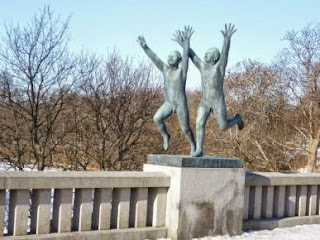
There’s no lack of artistic sculptures in Oslo, adding a lot more warmth to the city and complementing the abundant pockets of green space in the cityscape.  Being the world’s largest sculpture park made by a single artist, Oslo’s Vigeland Park was considered quite avant-garde at the time it was created in the 19th century.  Home to 227 granite and bronze sculptures, the sculptures were created by Norway’s famous sculptor Gusrav Vigeland,  I really like how there is a display of so many different emotions in the sculptures, not just facial expressions, but also very expressive body language, ranging from the affection between humans to the experiences of a child from birth to death. The focal point in the park is the cycle of life monolith which is a huge monolith of bodies with circles of statutes depicting the cycles of life.  With 121 figures carved from a single granite block of 17.3m, it shows Vigeland’s interpretation for the human’s longing and yearning for the spiritual and divine.  One of my favorite sculptures is the Wheel of Life, which displays connecting humans through happiness, sadness, anger, and fear.  It is also a symbol of eternity in the use of a garland of women, men and children holding hands.




Friday, June 7, 2013

Vilnius

City of churches 

The snow only got heavier as we got into Vilnius from Riga.  It almost felt like Christmas in the middle of April!  With 65 churches nestled in the historic Old Town of Vilnius, which is listed on UNESCO’s World Heritage sites, it isn’t hard to miss the various types of cathedrals and churches dotted at almost every corner.  Amongst them, Vilnius Cathedral and St. Anne’s Church are the most well-known. Vilnius Cathedral is the main Roman Catholic Cathedral of Lithuania and has over forty frescoes and paintings dating back to the 16th century.  Even the coronations of the Great Dukes of Lithuania took place in the cathedral.  St. Anne’s Church is a signature red-bricked Roman Catholic church built in a gothic style.  Vilnius University also lies amongst these beautiful historic buildings.

 After a walking tour of the Old Town in the morning, we headed towards the famous island castle Trakai in the afternoon. Located in Lake Galve, this 14th century castle is a real life version of Lego castles that I used to love building as a kid.  Complete with a connecting bridge, defensive towers, movable gates, stables and more, the castle did serve a military purpose at the beginning and later evolved into a summer residence, a prison and now a tourist location!  It was pretty cool seeing locals fishing in the middle of the frozen lake-must need a lot of patience for that, especially in the freezing cold weather!

As my trip in the Baltic countries wraps up, I head to Oslo-a beautiful city filled with artistic sculptures!


Thursday, May 23, 2013

Riga

A touch of Latvia 

As the capital and largest city of Latvia, Riga has a historic area-Old Town Riga, which gathers some beautiful architecture.  One that stood out for me was the House of Blackheads in Town Hall Square, which was rebuilt in 2001 to commemorate the city’s 800th anniversary.  Originally owned by a merchant guild, it currently serves as a museum and concert hall.  It was destroyed in 1941 and buried by the Soviets in 1948.  Ironically, it sits next to the Museum of Occupations, which houses information boards and exhibits on what the Latvian people endured during the Nazi occupation followed by the “Russification” of the country when the Soviet Union took over the country.  Hundreds of thousands of Russians moved across the Soviet Union to Latvia to work during the Russian occupation.  Today, about a third of the population in Latvia are made up of Russians, and half of the population speaks Russian.  We weren’t surprised to see Russian on the streets and in cafes.  But beneath the calm surface, there are many ethnic divides between Russians and Latvians and language is just the beginning.

 By the time we made it to Rundale Palace, a beautiful baroque palace built in the 18th century just outside of Riga, it was snowing like mad and summer time is definitely a better time to visit the palace when the flowers in the gardens are in full bloom.  But the snow didn’t ruin our spirits as the palace is splendid inside, especially the detailed ceiling paintings in the ballrooms and halls.  There is even a dedicated space that house porcelain pieces.    

 My trip in the Baltic countries continues on with Vilnius!


Monday, May 13, 2013

Trip back in time

Medieval Tallinn 

The overnight cruise from Stockholm to Tallinn was around 16 hours, from 6pm to 10am the next morning.  For someone who gets easily seasick, I found the cruise to be pretty calm, and I had plenty of time to take in the gorgeous views of the sunset before heading to bed early.  The next morning, I woke up to the sound of the boat cruising through broken ice sheets.  Everything was very calm and I had an enjoyable breakfast right by the window offering a nice view of offshore wind turbines from a distance.

 Not before long, we reached Tallinn, where we first visited Toompea Hill followed by the historic city centre.  Before climbing up the steps to Toompea Hill, we came across the Russian Orthodox Alexander Nevsky Cathedral.  This magnificent onion-domed structure was built in 1900 during the tsarist Russian empire.  The inside is filled with colourful and intricate mosaics and it also has 11 church bells which sound off before service.  The largest one weighs over 15 tonnes!  We gradually came to the viewing platform which is the perfect spot for a panoramic view of Tallinn with a skyline of old new buildings.  The neat thing is that there are always photogenic pigeons hanging out here.  It might have to do with all the vendors selling roasted almonds in the area.  You can spot St. Olaf’s church in the distance from the platform.  This was the tallest building in the world from 1549 to 1625.  Its 159-metre spire was a very effective lightning rod and throughout the church’s history, its steeple has been hit three times, completely burning the entire structure three times!  Now, the steeple is 124-metres, a much less likely target than before.

 We walked downhill into Old Town which is filled with charming twisted cobblestone paths reminiscent of Medieval times.  We settled into the Olde Hansa Medieval restaurant for lunch, where all the servers were dressed up in Medieval costumes.  It can’t get more authentic than this!  The bathroom was quite amusing as it was pitch black and we had to move in a bunch of candles to make sure we could see well enough and rather than having a tap, a pot of water had to be tipped over in the sink area to wash our hands, very interesting indeed.  The 2km city wall surrounding the historic district is still intact and dates back to the 13th century.  Gothic architecture can be found throughout the district, including the Town Hall, which is the only Gothic town hall still intact in Northern Europe.  Another well-known landmark is the Pharmacy, a small little shop in Town Hall Square which dates back to 1422.  It is the oldest continuously running pharmacy in Europe and has been operated by ten generations of the same family.  It was famous for specialty items such as snakeskin potion, powdered unicorn horn, as well as every day items like tea and marzipan. Today, it’s still a pharmacy, but sells modern products.

 My fascination with famous old towns in Northern Europe continues at the next stop: Riga!


Monday, May 6, 2013

Stockholm City Hall

Site of the Nobel Prize banquet

Stockholm City Hall is one of the iconic landmarks in the city, also known as the Stadshuset.  It sits on Kungsholmen, one of the many islands that Stockholm spans across.  City Hall’s Blue Hall is well known for being the venue of the annual Nobel Prize banquet.  Nobel Laureates for all the Nobel Prizes, except for the Nobel Peace Prize, gather in this hall after the awards ceremonies at the Stockholm Concert Hall each year for a celebration banquet.  For those who want to experience the nobility of the banquet but who are not on the guest list of 1,300 on December 10 each year, the luxurious cellar restaurant Stadshuskallaren in the building offers the previous year’s menu.

 Blue Hall isn’t actually blue as it was named after Ragnar Ostberg’s original designs which did have blue glazed tiles for the hall but he later changed his mind seeing how beautiful the red bricks used in the construction of City Hall are on their own.  There’s a magnificent organ in Blue Hall which is made from 10, 270 pipes, the largest in Scandinavia.  A well known part of City Hall is Golden Hall with its more than 18 million glass and mosaic pieces showcasing pictures of Swedish history.  After dining in Blue Hall, guests are invited to dance in the Golden Hall.  Another interesting space in City Hall is the Council Chamber which has an open roof inspired by a Viking longhouse.  Nearly eight million red bricks were used in the construction of the hall itself.  From the courtyard, the site overlooks Riddarfijarden and offers picturesque views of central Stockholm.  I also love the sculptures by famous Swedish sculptor Carl Eldh by the water-a female Dansen and male Sangen, Swedish for Dance and Song.

 Watch for my next blog for pictures of the cruise from Stockholm to the beautiful city of Tallinn!


Saturday, April 20, 2013

Copenhagen

City of bikes, fairytales and beer! 

I’ve always wanted to visit Copenhagen with its reputation as a major biking city and environmental hub, especially after the COP 15 meeting in 2009.  Like many bike-friendly cities, the city’s dedicated bike lanes are well-used and has a convenient bike rental/sharing system in the downtown area that allows anyone, tourists especially, to hop on and off bikes with a simple deposit which you get back when you return your bike back to any of the numerous bike stands.  Steer into the countryside and you might even catch some gorgeous views of wind turbines.  It’s absolutely amazing that close to half of Copenhagenians cycle to work or school!

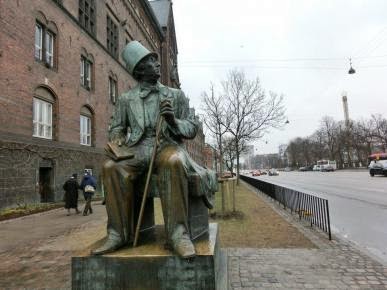
 A biking/walking tour is perfect for a Hans Christian Anderson tour.  You’ll find traces of this storyteller and the characters from his tales all over the city.  There’s a statue of him next to city hall and across from the Tivoli Gardens (the world’s 2nd oldest amusement park).  Anderson’s famed nymph-The Little Mermaid by the harbour has been the icon of Copenhagen for some time.  She has been the centre of attention for tourists and political activists alike.  Apparently her head had to be replaced several times as activists kept sawing it off.  There are also plenty of hidden alleyways and old squares that make this fairytale city so charming.  On a side note, for those who are Shakespearean fans, check out the Kronborg Castle.  It was still under renovation when I went, but it was here that the Bard set his famed play Hamlet.

 While you’re by the harbour, the colourful facades of the Nyhavn waterfront makes it a great spot for photos and with the numerous bars and cafes, it’s also excellent for people-watching!  Can’t get enough beer?  Check out the Carlsberg Brewery Musuem where there are over 20,000 vintage beer bottles.  There are also 8 Jutland horses in the stables that you can visit and they also do wagon rides.  By the time I’ve tried just about every beer there was available at the brewery, it was about time to hit the sack.

 Next up: Sweden!


Monday, April 8, 2013

Iran's capital

Traffic mad Tehran

The first thing I noticed when I arrived in Tehran was the traffic.  Compared to Yazd, Shiraz and even Isfahan, this city is packed.  It’s not surprising that this city made it into the World Health Organization’s list of the world’s 10 most polluted cities.  Being the fifth largest city globally with over 12 million people, the city also has 3.5 million cars, aged cars that is.  The majority of cars are Iran assembled French or Korean cars.  Though the air wasn’t too bad when I went, the city did experience a five-day closure of government offices, schools and banks because of air pollution early this year.  Because of the sanctions on imports of refined gasoline, the country has resorted to producing its own gasoline.  To try to limit the number of cars on the roads, the government has imposed an odd-even traffic control plan based on the last digit of license plates.  But it is a good thing that Tehran is continually expanding its subway system.  While women and men are separately seated on buses in Iran, on subways, the first, last and half of the second and second to last cars are reserved for women but women are still free to ride on other cars freely.

 Tehran is a pretty cool city with a mix of the new, the traditional and the in-between.  The contemporary Azadi or Freedom tower situated in the middle of Tehran’s famous Azadi Square, where many demonstrations leading to the Iranian Revolution took place, is a key symbol of Tehran.  The recently built (2007) Milad Tower stands high at 435m is the sixth tallest tower in the world and offers panoramic views of the entire city.  During my stay in Iran, I had the chance to stay in a few hotels throughout Iran and I’ve got to say that these must have been the best hotels with top notch standards…when they were owned by brand name hotel chains before the 1970s.  Now they’re all government owned.  Being a child of the 80s, it felt like going into a time capsule and landing in the 60s and 70s since the furniture felt pretty retro but at least they were all quite clean!

 One of the draws to Tehran is the National Jewels Museum which houses jewels collected by the Iranian monarchy during its 2,500 year existence, the majority of which were acquired by the Safavid dynasty which ruled from 1502 to 1736.  The crown jewels were last used by the Pahlavi dynasty, which was the last to rule Iran and it was Mohammad Reza Pahlavi, the last king, who decided that the best of the best jewels should be on public display.  You wouldn’t have known that the museum is actually in the basement of the central branch of Bank Melli just by looking at the façade of the inconspicuous building on the outside.  The museum has pretty odd hours as it is opened only from Mondays to Wednesdays for three hours in the afternoon and everyone is required to go on a guided tour.  No one can bring anything inside and there’s of course a security check, so unfortunately I’ve got no pictures, but you’ve always got to see these precious goods for yourself anyways, not just through a picture that somebody else has taken!  One of the must-sees is a jewel-studded globe with over 51,000 gemstones including rubies, emeralds and diamonds and 35kg of pure gold!  The museum also houses one of the largest diamonds in the world, the Sea of Light pink diamond, weighing around 180 carats.  The extravagance doesn’t end there-there’s a Peacock throne that is just covered with gold and encrusted with 26,733 jewels.  My eyes were seriously a little tired from staring at all the glittery jewels in this museum!

 Watch for my upcoming blog posts on my recent trip to Northern Europe and the Baltic countries!